Gentle Breast Massage After Mastectomy Benefits Recovery Circulation and Scar Tissue Relief

Healing after a mastectomy is physical, emotional, and deeply personal. The skin may feel tight. The chest wall may feel numb, tender, swollen, or unfamiliar. Even small movements, like reaching for a mug or putting on a shirt, can remind the body of what it has been through.
Gentle massage can be one supportive tool during recovery. When done at the right time and with the right guidance, it may help ease tightness, support healthy circulation, soften scar tissue, and reconnect a person with their body in a calm, careful way.
This article is for general education only. Always follow the guidance of your surgeon, oncology team, physical therapist, or lymphedema specialist before beginning breast or chest massage after mastectomy.

Why gentle massage can support mastectomy recovery
After mastectomy, the tissues across the chest, underarm, shoulder, and upper ribs often need time to settle. Surgery can affect skin, fascia, nerves, lymph vessels, and muscles. Some people also have lymph nodes removed, reconstruction, radiation, or additional procedures that change how the area feels and moves.
Massage does not “fix” recovery, and it should never replace medical care. But gentle, well-timed bodywork can support the healing process in several ways.
It can help reduce tightness and guarded movement
After surgery, many people naturally protect the chest by rounding the shoulders, holding the arm close, or avoiding reaching. This makes sense at first. The body is trying to keep the area safe.
Over time, that protective posture can lead to stiffness in the chest, shoulder, neck, and upper back. Gentle massage around the chest wall, shoulder, upper arm, and ribs may help the nervous system relax. When the tissues feel less guarded, movement often feels less intimidating.
One survivor, “Angela,” a composite story based on common recovery experiences, described the first few weeks after surgery as feeling “like wearing a tight vest under the skin.” With clearance from her care team, she began light touch around the healed incision and shoulder. She did not press hard. She simply worked slowly, a few minutes at a time. Over several weeks, she noticed she could lift her arm more comfortably during daily tasks.
It may improve comfort by supporting circulation
Massage can encourage local blood flow in the skin and surrounding soft tissues. Better circulation brings oxygen and nutrients to healing tissue and helps carry away normal metabolic waste. This does not mean massage should be intense. In fact, after mastectomy, light pressure is often more appropriate than deep pressure, especially early in recovery.
Some people also benefit from gentle lymphatic-style techniques. The lymphatic system helps manage fluid balance. Surgery, lymph node removal, and radiation can affect lymph flow, which may contribute to heaviness, swelling, or a feeling of congestion.
If there is a risk of lymphedema, a certified lymphedema therapist or a certified lymphatic massage therapist should guide care. Lymphatic massage uses very light, specific strokes. It is not the same as deep tissue massage.
It can help soften scar tissue over time
Scar tissue is a normal part of healing. In the early phase, scars need protection. Later, once the incision is fully closed and cleared by a clinician, scar massage may help keep the tissue more flexible.
Scar tissue can sometimes feel raised, rope-like, tight, itchy, or stuck to deeper layers. Gentle scar mobilization may help the skin glide more easily over the tissues beneath it. This can make reaching, dressing, bathing, and sleeping more comfortable.
Progress is usually gradual. Scar tissue changes over months, not days. The goal is not to erase the scar. The goal is to help the area move with less pulling and discomfort.
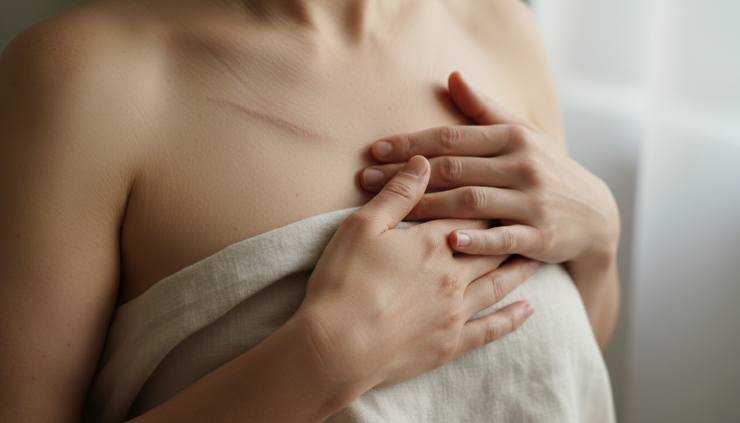
When massage is safe and when to wait
Timing matters. Massage too soon, too hard, or in the wrong area can irritate healing tissue. Before starting, ask your care team whether massage is safe for your specific surgery and stage of recovery.
Wait to massage the surgical area if you have:
Open incisions or scabs
Surgical drains still in place
Signs of infection, such as warmth, spreading redness, fever, or pus
New or worsening swelling
Unexplained pain
A suspected blood clot
Radiation burns or fragile peeling skin
A fluid pocket, also called a seroma, unless your clinician says otherwise
New numbness, tingling, or heaviness that has not been evaluated
Also pause massage if it causes sharp pain, increased swelling, skin color changes, dizziness, or emotional distress that feels overwhelming.
After mastectomy, some numbness is common because small nerves are cut during surgery. Numb areas still need caution. Lack of sensation can make it easier to use too much pressure without realizing it.
A helpful rule is this: massage should feel soothing, neutral, or mildly tender at most. It should not feel painful or aggressive.
Step-by-step techniques for safe and effective massage
These techniques are gentle starting points. Use them only after medical clearance. If you had reconstruction, lymph node removal, radiation, complications, or lymphedema risk, ask a qualified therapist to show you what is appropriate.
Choose a quiet place. Sit slightly reclined or lie on your back with pillows under the head and knees. Wash your hands. Use a small amount of unscented lotion or oil if your skin tolerates it. Avoid products on irritated or radiated skin unless your care team approves them.
Start with 3 to 5 minutes. You can build slowly if your body responds well.
Step 1. Begin with grounding breaths
Place one hand on the upper belly or lower ribs, away from the incision if needed. Let the shoulders drop.
Breathe in through the nose for a comfortable count. Breathe out slowly through the mouth. Repeat 4 to 6 times.
This step tells the nervous system it does not need to brace. Many people skip it because it seems too simple, but it can make the rest of the massage feel safer.
Step 2. Warm the surrounding areas first
Before touching the scar or chest wall, massage nearby areas that often hold tension.
Use gentle circles or light gliding strokes on:
The upper arm
The shoulder
The collarbone area, avoiding direct pressure on tender spots
The upper back or side ribs if reachable
The neck, with very light pressure
Keep the hand broad and soft. Think of moving the skin, not digging into the muscle.
Step 3. Use light chest wall strokes
Place your fingertips or flat hand on the chest wall near, but not directly on, the scar if the area is still sensitive. Glide slowly across the skin in small sections.
Work in short paths:
From the center of the chest outward
From the upper chest toward the shoulder
Along the ribs, staying gentle
Around the healed incision, not over it at first if it feels tender
Use enough lotion so the skin does not drag, unless your therapist recommends dry scar work. Keep pressure light, especially over numb areas.
Step 4. Try gentle lymphatic-style sweeping
This is not a full lymphedema treatment, but it can be a calming technique when approved by your clinician.
Use feather-light pressure. The skin should stretch slightly, not slide deeply.
Try this sequence:
Place the hand above the collarbone and make small, gentle circles.
Move to the healthy side of the chest and repeat soft circles.
Sweep lightly from the affected upper chest toward the center of the chest, only if approved.
Sweep from the upper arm toward the shoulder with a soft, slow touch.
Stop if swelling, heaviness, or aching increases.
If you have had lymph nodes removed, personalized instruction is best. Lymph flow patterns can differ depending on surgery and treatment.

Step 5. Add scar massage after the incision fully heals
Only massage the scar once the incision is fully closed and your care team says it is ready. This may be several weeks after surgery, sometimes longer.
Start around the scar before working directly on it.
Use one or two fingertips and try these gentle movements:
Small circles
Move the skin in tiny circles along the length of the scar. Keep the pressure mild.
Side-to-side motion
Place the fingers on the scar and move the skin slightly left and right. Do not rub hard.
Up-and-down motion
Gently shift the scar tissue upward and downward. Stay slow.
Skin lifting
If the scar is not tender, gently lift the skin between the fingers. This can help with areas that feel stuck, but it should never feel sharp or burning.
Spend 1 to 2 minutes on scar work at first. More is not always better. A little, repeated consistently, often works better than one long session.
Step 6. Finish with easy movement
After massage, try gentle range-of-motion movements if your care team has approved them.
Examples include:
Shoulder rolls
Slow arm slides on a table
Gentle wall walking with the fingers
Neck stretches
Opening and closing the hands
Massage and movement often work well together. Massage helps the area relax. Movement teaches the body how to use that new comfort.
What recovery can feel like emotionally
Massage after mastectomy is not only about tissue. Touch can bring up grief, relief, fear, anger, gratitude, or a mix of feelings that change from day to day.
Some people feel ready to touch the surgical area early. Others need weeks or months before they can look at or place a hand on the chest. Both responses are valid.
A composite story from “Denise” reflects what many people describe. She avoided touching her scar at first because it made the surgery feel too real. Her physical therapist suggested placing a hand over her shirt for 30 seconds at a time, with no massage at all. After a few days, she added slow breathing. Later, she used lotion around the scar. The process helped her feel less disconnected from her body.
Another person might have the opposite experience. “Renee,” also a composite example, found self-massage comforting because it gave her something gentle to do between appointments. She liked having a routine that was not focused on tests, medications, or results. It helped her feel involved in her own healing.
There is no single emotional timeline. The body has been through a major change. Kindness matters as much as technique.
How to find a qualified therapist
The right therapist can make a major difference. After mastectomy, look for someone with training in oncology massage, post-surgical rehabilitation, scar mobilization, or lymphedema care.
Good options may include:
A licensed physical therapist with breast cancer rehab experience
An occupational therapist trained in lymphedema or oncology rehab
A licensed massage therapist with oncology massage training
A certified lymphedema therapist.
A therapist recommended by your breast surgeon, oncologist, or cancer center
Ask direct questions before booking.
You can ask:
What training do you have in post-mastectomy care?
Have you worked with people after mastectomy, reconstruction, radiation, or lymph node removal?
Do you understand lymphedema precautions?
Will you coordinate with my medical team if needed?
What pressure level do you use after cancer surgery?
Can you teach safe self-massage for home?
What symptoms would make you stop a session?
A qualified therapist should welcome these questions. They should not promise to remove all scar tissue, cure lymphedema, or speed healing in a guaranteed way. They should ask about your surgery, treatment history, current symptoms, restrictions, and comfort level.
Trust your instincts. If a therapist pushes deep pressure, dismisses pain, or seems unfamiliar with mastectomy recovery, it is reasonable to leave and look for someone else.

Simple tips for a supportive home routine
A home routine does not need to be long or complicated. The best routine is one that feels safe enough to repeat.
Try these practical tips:
Keep sessions short, especially at first.
Use a mirror only if it feels helpful.
Massage over clothing if direct skin contact feels like too much.
Track what feels better or worse afterward.
Avoid comparing your recovery with anyone else’s.
Stop before the area feels irritated.
Pair massage with music, breathing, or a warm shower if approved.
Ask a therapist to watch your technique and adjust it.
Some people like doing massage at the same time each day. Others prefer to use it only when tightness appears. Either approach can work.
If you have a partner who wants to help, ask your care team or therapist to teach them safe touch. Supportive touch can feel comforting, but the person helping needs clear instructions about pressure, direction, and areas to avoid.
A gentle takeaway for healing
Gentle breast massage after mastectomy can be a meaningful part of recovery when it is done safely. It may improve comfort, support circulation, reduce tightness, and help scar tissue become more flexible over time. Just as important, it can offer a quiet way to reconnect with a body that has carried you through something difficult.
Start slowly. Get medical clearance. Use light pressure. Ask for help from a qualified therapist when needed. Healing is not a race, and massage should never feel like one.
The most helpful touch is patient, respectful, and guided by what the body is ready for today.


Comments